
Lawrence County Court Records After a Jail Arrest
After a Lawrence County arrest, the jail roster and the court system answer different questions. The Lawrence County Jail records the custody event at book-in. The Lawrence County Circuit Clerk points criminal-case users to Missouri Case.net, where public court cases may show docket entries, parties, judgments, and charges. The clerk's Criminal Department processes criminal cases filed by the Lawrence County Prosecuting Attorney's Office, from minor traffic matters through serious felony cases.
The local prosecutor is Darlene Parrigon, listed in the Missouri Association of Prosecuting Attorneys directory as the Lawrence County Prosecuting Attorney. Her office address is 240 N. Main, Suite 210, Mt. Vernon, MO 65712, and the directory phone is 417-466-2846. That office's filing decision is the practical bridge between an arrest and the court records that follow. Booking language on the jail roster may be broad or preliminary; the prosecutor-filed charge in court is the allegation that the case actually tracks.
Use the jail side for custody and booking details such as booking number, booking date, visible bond, and active detention status. Use Case.net and the Circuit Clerk for the court record after arrest, including charge counts, docket activity, hearings, bound-over events, pleas, dismissals, judgments, and copy requests. For the custody side, see jail inmate records. For booking-photo details, see jail roster mugshots.
The Lawrence County Circuit Clerk's public case-search page links to Case.net and explains that access is limited to cases that are public under Missouri law and filed in courts using Missouri Court Automation Program software. The clerk also explains that public court documents filed on or after July 1, 2023 may be viewed, downloaded, or printed remotely through Case.net if the document itself is public.
How to Find Court Records After an Arrest in Lawrence County
Start with the Lawrence County Circuit Clerk case-search page, then continue to Missouri Case.net. If the person was booked very recently, the court case may not appear until the prosecutor files and the clerk's office processes the case. For a traffic matter, the local clerk instructs users to search by litigant name, select the 39th Judicial Circuit, enter the year the ticket was issued, and click Find.
- Open the Circuit Clerk's case-search page and follow the Case.net link.
- Search by litigant name first, using the defendant's legal name as it appears in the roster or ticket.
- Select the 39th Judicial Circuit when the search form asks where to search.
- Use the case year or case number when known to narrow common names.
- Open the case record and compare each court charge against the jail booking charge.
- Review docket entries, hearing history, bond orders, charge amendments, judgments, and disposition language.
| Case.net Field | Use | Local Notes |
|---|---|---|
| Litigant name | Name search | The Circuit Clerk specifically references searching by litigant name for traffic matters. |
| Search For Cases In | Jurisdiction filter | Select the 39th Judicial Circuit for Lawrence County court records. |
| Year Case was Filed | Date filter | The clerk tells traffic users to enter the year the ticket was issued. |
| Case number | Exact lookup | Useful after the case number appears on paperwork, a docket notice, or another court record. |
| Public document access | Document viewing | Public filings on or after July 1, 2023 may be remotely viewable if not restricted. |
The Circuit Clerk's Criminal Overview page gives the Criminal Department phone as 417-466-2471 option 8. It also says case-copy requests may be sent to lawrencecounty@courts.mo.gov. For traffic cases that cannot be found in Case.net, the clerk says to call 417-466-2471 option 2.
The Circuit Clerk case-search page is the local entry point for public Case.net searching.
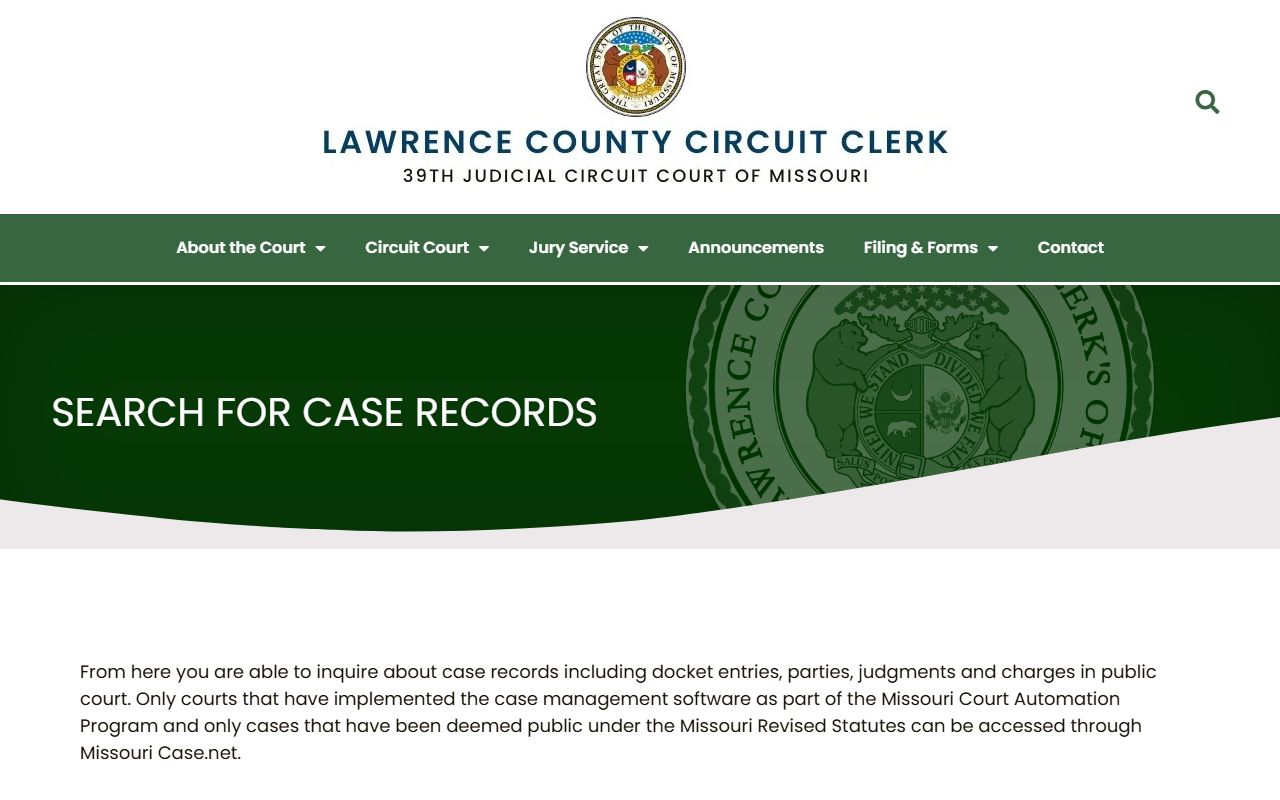
The screenshot shows the local court-records pathway before the statewide Case.net search. That distinction matters because the clerk's office, not the jail roster, controls case-copy routing and court-record access.
Charging Documents After an Arrest
A jail arrest creates a booking record, but the court charge begins when the prosecuting authority files a charging document or the court otherwise opens a criminal matter. Lawrence County research confirms that the Circuit Clerk's Criminal Department handles cases filed by the Prosecuting Attorney's Office. The same office processes case initiations, pleadings, dispositions, bound overs from associate to circuit level, record requests and copies, and license suspensions.
Missouri criminal cases may use different charging-document labels depending on the case type and stage. The local research does not publish a Lawrence County-only charging form, so the safest reading is procedural: look at the court docket and filed documents, then treat those documents as the controlling charge record.
| Document | What It Usually Does | How to Read It After a Lawrence County Arrest |
|---|---|---|
| Complaint | Starts or supports a criminal allegation in court. | Compare it with the jail booking charge, but rely on the filed court language for the case. |
| Information | Prosecutor-filed charging document often used after review. | Look for the charge count, offense description, degree, statute reference if listed, and filing date. |
| Indictment | Grand-jury charging document in qualifying cases. | Serious cases may proceed this way; the docket should identify the filed document and next hearings. |
| Amended filing | Changes a previously filed charge or count. | Do not rely on an older roster entry if Case.net shows amended or substituted charges. |
Charge Status in Court Records After an Arrest
Charge status is the part of a court record that often changes after a jail arrest. A person can be booked on one description, charged in court with another, and later see the charge amended, reduced, dismissed, bound over, or disposed by plea or trial. That is why the roster should not be treated as the final court record.
| Status | Meaning | Practical Check |
|---|---|---|
| Pending | The charge is open and no final disposition is shown. | Check upcoming hearings, bond orders, and any attorney entries. |
| Amended | The charge language, count, level, or statute basis has changed. | Read the newest filing and docket entry instead of the original booking text. |
| Reduced | The case moved to a lesser charge or lower offense level. | Confirm whether the reduction is tied to a plea, amendment, or other order. |
| Dismissed | The court record shows that a charge or case was dismissed. | Confirm whether all counts were dismissed or only one count in a multi-count case. |
| Bound over | A matter moved from associate-level handling toward circuit-level proceedings. | Look for the new case path and later filings after transfer. |
| Disposition entered | The case has an outcome such as plea, conviction, acquittal, dismissal, or sentence. | Read the judgment and sentence fields before summarizing the result. |
Bond and Release Records After a Jail Arrest
Bond information appears in Lawrence County jail and warrant records, but the controlling release condition comes from court authority. The roster examples in the research showed dollar amounts and "DENIED BOND." The warrant list showed dollar bond amounts and "No Bond." Those public lines are useful starting points, but they are not a substitute for the court order, the case docket, or direct confirmation with the jail or clerk.
The sheriff pages do not publish a bond-payment page, accepted bond-payment methods, or bonding-company instructions. For a live release question, call the Lawrence County Sheriff's Office at 417-466-2131 or check the court case. Holds and detainers can prevent release even when a dollar amount appears on one local charge. Examples include another court's warrant, probation or parole hold, DOC transport, federal matter, or immigration detainer.
| Bond Entry | How It Works | Lawrence County Source Support |
|---|---|---|
| Cash or dollar bond | A listed amount may be required under the court's release order. | Dollar amounts appeared on roster and warrant entries. |
| Denied bond or no bond | Release through bond is not available on that listed matter at the time shown. | "DENIED BOND" and "No Bond" were observed in county records. |
| Surety bond | A licensed bail agent may be involved if the court permits that form of release. | Missouri practice supports the term, but no local sheriff payment page was found. |
| PR release | Release on recognizance is a court-release concept that may not require full cash deposit. | Not observed in roster excerpts, so check Case.net before assuming it applies. |
| Hold or detainer | Another agency or case can block release. | No public roster detainer field was verified, so confirmation must come from the jail or court. |
Warrants That Lead to Court Records After an Arrest
The Lawrence County Sheriff's Office maintains an official warrant list after a disclaimer page. On June 20, 2026, the research observed 1,300 warrants. The list included search and sorting controls for name and date, pagination, and visible fields for name, age, warrant date, bond, and charges. The disclaimer says the information is maintained for convenience and is not certified as accurate or authentic.
A warrant can become the reason for a new jail booking, but a bench warrant may also be tied to an existing Case.net record. If a person is arrested on a warrant, check both places: the current jail roster for custody and the court case for the warrant docket entry, bond order, and later charge status. For confirmation, the local sheriff's 24-hour office phone is 417-466-2131.
Charge vs Conviction in Lawrence County Court Records
An arrest and a charge are not the same thing as a conviction. A charge is an allegation that must be handled through court process. A conviction is a final outcome based on a guilty plea, verdict, or other adjudication. When reading Lawrence County court records after an arrest, do not describe a person as convicted unless the case record shows a conviction or judgment that supports that statement.
| Point of Comparison | Charge | Conviction |
|---|---|---|
| Stage | Allegation filed or pending in court. | Final or adjudicated outcome shown by the court record. |
| Source | Charging document, docket entry, complaint, information, indictment, or amendment. | Judgment, plea entry, sentence, verdict, or disposition field. |
| Can change? | Yes. Charges can be added, amended, reduced, or dismissed. | May be appealed, corrected, sealed, or expunged only through court process. |
| How to verify | Read the active charge list and newest filings. | Read the final disposition and judgment entries. |
Sealed vs Expunged Arrest and Court Records
Missouri public-record access starts from an openness rule but includes exceptions. RSMo 610.011 states the state's public policy that governmental records are open unless a law provides otherwise. RSMo 610.140 provides a Missouri expungement path for eligible criminal records. The research did not identify a local Lawrence County shortcut for sealing or expungement, so the court process and Missouri statutes control.
| Point of Comparison | Sealed or Closed | Expunged |
|---|---|---|
| Public visibility | Public access is limited or blocked under a court order or statute. | Eligible records are restricted under Missouri's expungement process. |
| Where to confirm | Check the court docket, clerk records, and applicable Missouri law. | Check for an expungement order and any remaining statutory exceptions. |
| Effect on online records | A public Case.net document may become unavailable if legally closed. | Eligible records may no longer appear publicly in the same way after expungement. |
| What not to assume | A dismissal does not automatically mean every record is sealed. | Eligibility depends on the offense, timing, prior record, and court ruling. |
Missouri Public Access Rules for Arrest and Court Records
Several Missouri statutes affect records after a Lawrence County jail arrest. RSMo 610.100 defines arrest and incident reports and governs open and closed law-enforcement records. RSMo 610.023 requires a public-record custodian to act on a request as soon as possible and no later than the end of the third business day after receipt unless a detailed reason for delay is given. RSMo 610.026 covers allowed copy fees, including standard paper-copy limits and permitted staff or research costs.
Missouri also has a timing rule for certain arrests. RSMo 544.170 says a person arrested and jailed without warrant or process must be discharged within 24 hours unless charged by oath of a credible person and held by warrant. That statute is a legal timing rule, not a promise that every roster entry will produce a Case.net record within a specific number of hours.
Records-use limit: This website is not a consumer reporting agency under the Fair Credit Reporting Act, and the information here must not be used for employment, credit, insurance, tenant screening, or another FCRA-covered decision.